

Cálmate, Corazón and a present for you.
What the worst week of my life taught me about living with kindness and self-compassion.

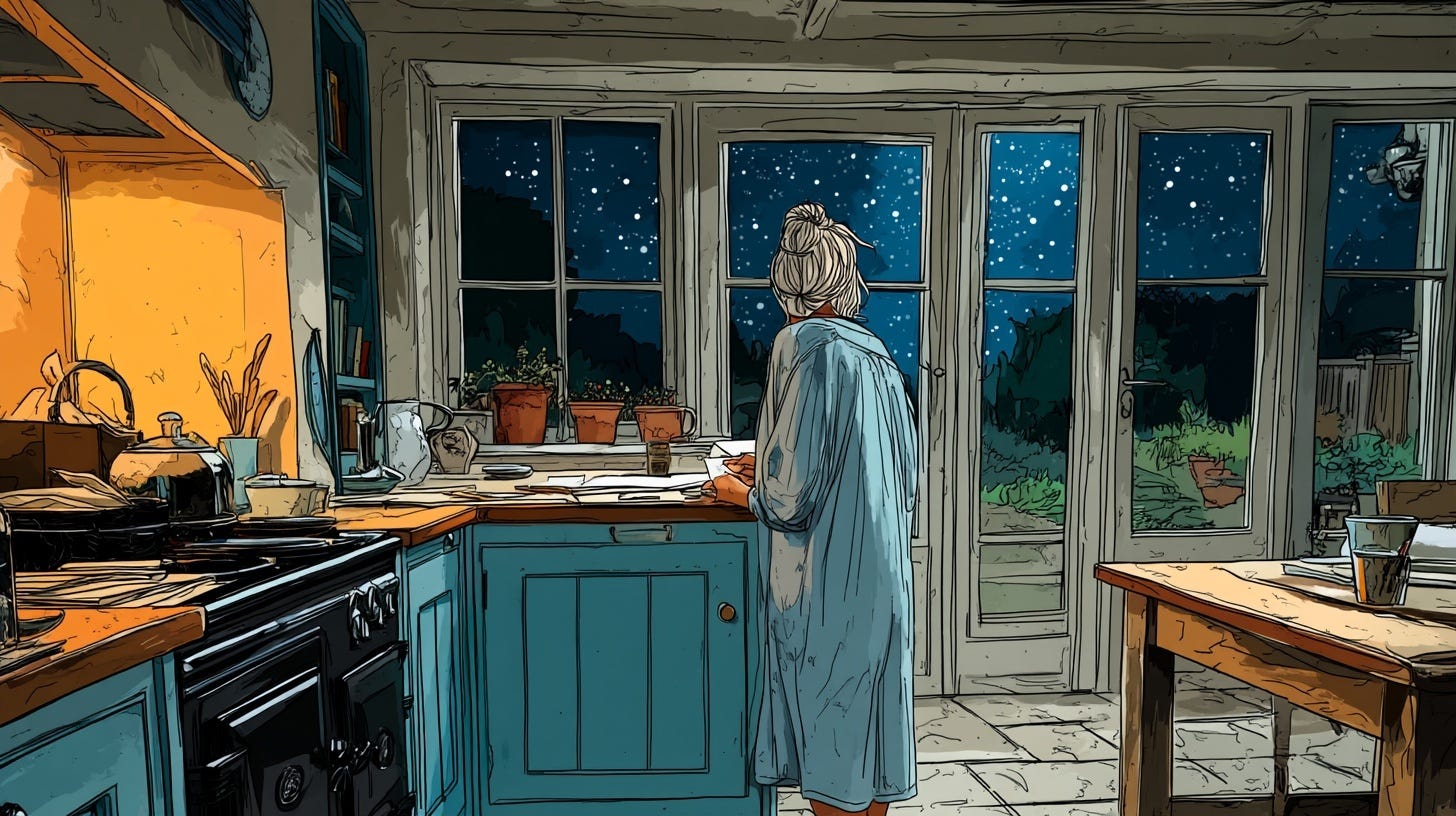
The first week after Sam died I spent a lot of time in the kitchen whilst everyone else was in bed. I couldn’t sleep more than two or three hours at a time. So I would come down and drink herbal tea and smoke at the kitchen table. And weep.
The Aga was dark blue. When I had chosen the house a year before, it was the Aga that beckoned me — this dark blue enamelled heart of the place, something on moving in that felt like an arrival, and that I had soon learned to lean into at the end of a long and stressful day at work. Now I sat with my feet cooled by the quarry tiles, the stainless steel jug that served as a kettle on the hotplate, its lid standing open. I sat at the huge IKEA table that had seated twelve for Christmas dinner the December before. Through the pair of glazed doors was the new courtyard garden my brother had landscaped for me, with its railway sleepers and its huge empty terracotta pots — pots that had been expecting cypress trees that very day, and now stood disappointed.
On the end of the table, a pile of condolence cards. Every day, clusters fell onto the doormat, the postman’s steps on the gravel echoing that other crunch of gravel — the police, calling round at three in the morning.
I had my diary and in the pauses between crying uncontrollably I tried to catch fragments of thought into some kind of to-do list.
A coffin. A song. A scary thought. Someone else to notify. A sudden memory. His phone contract. The car tax.
And underneath the lists, something much harder. In those solitary nights by the Aga I found myself turning over all the choices I had ever made, and questioning the kindness of each one. That husband. This school. That job. This house. That baby. The new bike. This decision, that decision. The countless choices I made — for myself, for my children, for other people — and the impossibility of ever seeing where their impact would land. It was overwhelming.
Over and over I landed in self-blame and in shame. Which was not living with kindness. Not at all. And yet to let go of it, to say with any kind of conviction, I did my best, I am a good mother, did not feel either possible or helpful. I felt as if I had an intractable puzzle to solve, no matter how painful. So I stayed there for long periods of time, where the self-blame was brutal. New and shocking realisations would surface and others would repeat and repeat, without mercy.
It was so harsh that no-one was able to listen to it without needing me to stop. To reassure me, “This is not your fault.”
So I saved it for the nights. On my own.
Two things came to support me in that kitchen, and I have kept them both.
The first was a name. My ex-husband, Danny, had a joky but affectionate name for me — Weenie. And in the small hours by the Aga I found myself using it, addressing myself the way someone who loved me might. “Come on, Weenie, make a cup of tea.” Or, “Not now Weenie. That one can wait.” Or simply, “It’s OK, Weenie. It's all right.”
The second came from the title of a book.
Over the last year I had bought a small book of cartoons — pithy advice for someone going through something really hard — and put it on my shelf, vaguely thinking it might be useful for my job as a pastoral leader in a large secondary school.
One of the Year 11 students in my house lost her mother to suicide. She and I went out one lunchtime for a hot chocolate at a nearby café with a courtyard garden. The tables were enclosed by potted plants and tall palms — parlour palms, probably not, but something like them — so that we sat half hidden. Through the leaves I could see one of my maths colleagues, puffing away behind a plant of his own.
My student's hot chocolate came with whipped cream and a long spoon. I had a black coffee.
She looked around, and glanced at her bag, trying to gauge what to do. I knew what she needed. I said quietly, “You can smoke if you want to. It’s OK.” And so she got out her rolling tobacco.
I decided in that moment that if it helped her just a tiny bit, I would risk whatever criticism — trouble even — might come my way for allowing it.
And now, in my kitchen, I understood instinctively that I must afford myself every small kindness that occurred to me. I allowed myself to smoke, rolling one skinny cigarette after another.
I fetched the little white and blue book from my shelf. Cálmate, corazón. Be still, dear heart.
I don’t recall its content as being particularly helpful but I adopted the title phrase, uncertain even how to pronounce it. When my panicked thoughts raced with the harshest of self-criticisms and brought me to more floods of tears — Cálmate, corazón.
As the weeks and months went on, I was unable to return to work, and allowing myself that was part of it. I made it a practice to take the kindest route — to try to do what was kindest for myself. And for my children, and for everyone else. But it started with me. To do what was kind. To choose what was kindest — not what was expected, or sensible, or agreed with everyone else, but what was kind.
I tried not to plan for the future, and yet, of course, some of what was kind now was inevitably shaping it. I knew from the start that I would survive this. I did not know how. And it seemed to me that kindness was the best compass.
The vehicle for that kindness that I discovered in my kitchen is self-compassion.
The roots of the word tell you what it is. Compassion — from the Latin com, with, and pati, to suffer. To suffer with. To carry something alongside another.
And self-compassion is carrying something alongside yourself. The willingness to suffer with yourself. Not to fix the pain, not to explain it away, not to stand over yourself in judgement — but to stand beside your own suffering the way you would stand beside a dear friend in theirs.
“With self-compassion, we give ourselves the same kindness and support we’d give to a good friend.” — Kristin Neff
Kristin Neff names three aspects to practising self-compassion. Here they are, as I understand them:
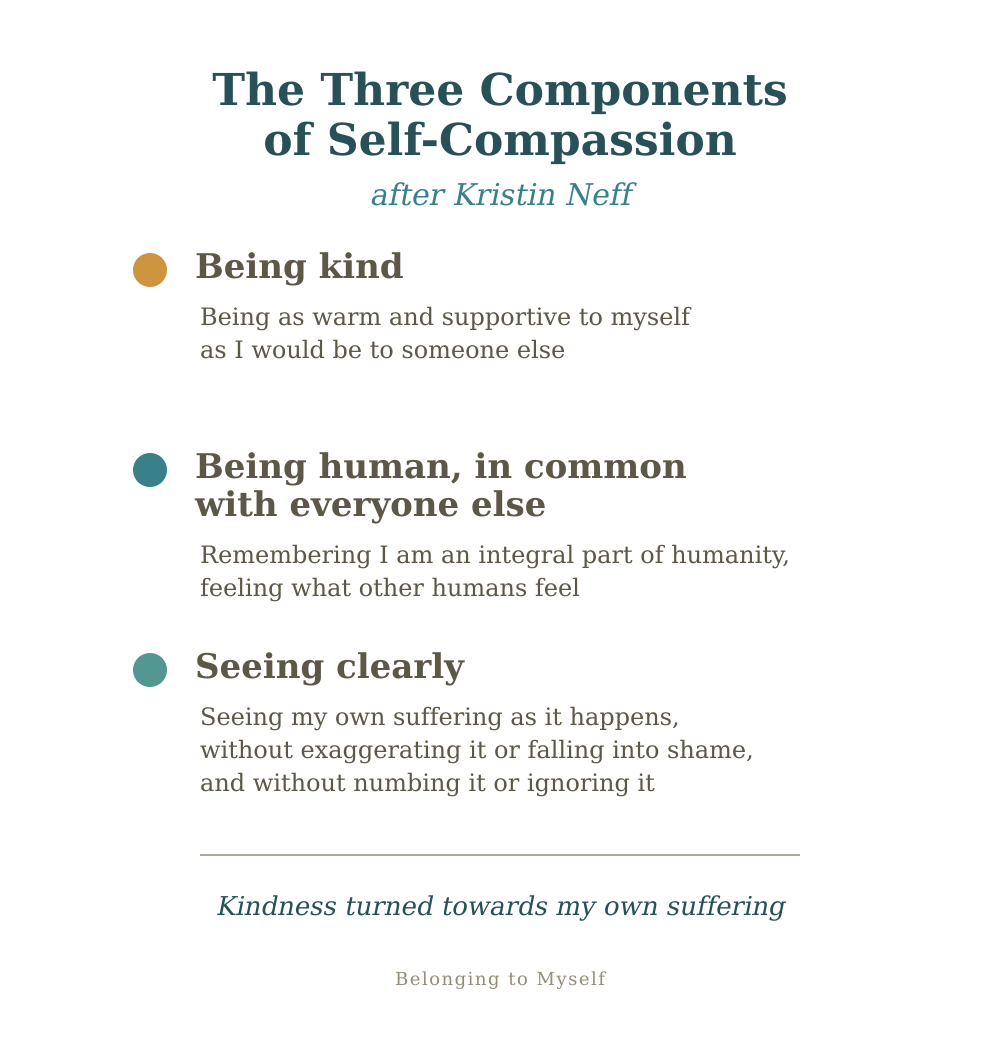
That middle one, being human, is the part that undoes the sense of isolation. When I remember I am part of humanity my suffering stops being mine, set against everyone else’s, and it becomes simply suffering, that can be met with kindness, wherever it happens to live. There is a temptation for us to imagine there is something wrong with us when we have a lot of suffering to deal with.
And when we see clearly we can see that, for example, I am having the thought that this is my fault and it is painful, without being tempted to numb it or ignore it.
This is what I have come to understand self-compassion to be: kindness turned towards my own suffering. The same kindness I would offer anyone.
I started to learn this it by the Aga, saying Cálmate, corazón to a heart in deep pain that I did not yet know how to comfort. And by holding myself with love through a name that was coined in love. Weenie.
We are sometimes encouraged to fill our own cup in order that we have enough to give to others — as though self-compassion only earns its place by making us better for other people. But I did not deserve kindness in that kitchen because of what it would let me do for anyone else. I deserved it because I mattered. And I deserve it now because I matter. As do you.
There was, at that time, all manner of kindness and compassionate action coming towards me from others. But kindness to myself as self-compassion was vital too.
That kitchen was where I began to live more actively with self-compassion. Well — maybe not the start, but where it became a daily vital practice. And part of the ground I aspired to stand on.
And I did not always get it right. Sometimes, I fell into being kind to everyone but myself. The first night in the Nottingham hotel, I shared a bed with a friend, and a room with her and my brother. They could sleep. I could not. So I left the room and sat on the floor in the stairwell so as not to wake them with my crying.
I should have booked another room. Maybe someone else should have booked it for me. I was still operating under an old illusion — that to get what I needed I must first look after everyone else’s needs, that I could not simply ask for what I needed.
But that is another story, and I will come to it another time.
I have come to believe that kindness — and the noticing of chances to practise it — is the only thing that truly matters in this world.
I do not manage it every moment. Far from it. But I have come to see it — often most clearly in other people’s lives — as a principle worth living by.
But when it goes unbalanced — when what seems like kindness to another leaves the self abandoned, disregarded — then perhaps it was never kindness at all.
Over the years since those kitchen nights I have increasingly come to realise that we are not separate. And as the line between self and other thins, the distinction between self and other begins to dissolve. I see that a kindness is simply a kindness. The same, whether it is turned towards me or towards someone else.
And perhaps that is what it means to belong to myself. Not to be apart, but to be my own — and, in the same breath, one of many. A wave and the ocean.
I saw this clearly once, in a small moment. My little grandson fell and cut his knee, and I felt the sudden sharp pain of it in my own knee, mirrored. I went to him, and I heard myself murmur it — Cálmate, corazón — to him, or to myself, I couldn't tell. Kindness to him, kindness to me — in that moment there was no difference between them.
There is a tool here which is for all my readers:

A 26 question self-assessment quiz.
A review of your results that will tell you:
How kind to yourself are you?
How well do you understand yourself to be a member of humanity, rather than alone in your suffering?
How clearly aware are you about your own painful feelings?
Then:
A pdf of your reflection along with tiny practices to support you to download and keep.
The self-compassion scale itself was designed by Kristin Neff, who generously allows its use. I have added some reflections of my own, and some small supportive practices, for anyone who wants to see where they are with this. Just to notice.
My tool is here, if you’d like to try it. You are so welcome.
Thank you for listening.
Davina 💙
Davina, another lovely post. You put so much thought and practice into this, and share your gift with others! The deepest form of love! Thank you for being you, and allowing yourself to belong to all of us!
This was such an enlightening read Davina and I am so grateful to you for developing and sharing this wonderful self-compassion tool. I love what you said about realising the importance of allowing every small kindness to yourself in your suffering, and of noticing the chances to practice kindness. Reading your insightful words has helped me to realise that I may slowly be developing the muscle of self compassion in learning to be willing to suffer with myself, and not to ignore, abandon or attack myself further in that suffering. It is such a simple thing but I have found holding my heart to feel such a powerful act in acknowledging my pain and offering the intention to soothe and comfort myself ❤️